 Ant Laboratory
An ant colony simulator for iPhone, iPad and Mac
One queen.
A whole living world.
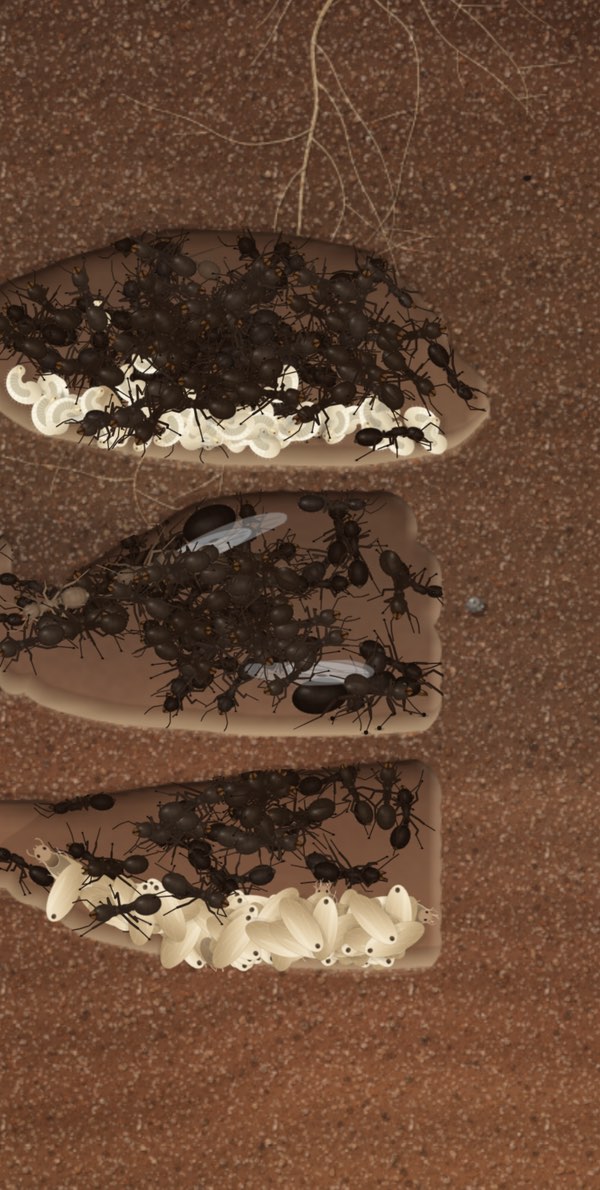
Watch her first workers dig, forage, raise their young and hunt together. Follow one ant close up, or let the colony spread across an island of its own.
A world to watch. A laboratory to explore. At your pace.
Take a closer look Watch the trailer

Coming soon to the App Store

Coming soon to Steam:
Windows and Mac
US$4.99 on the App Store, paid once, for iPhone, iPad and Macs with Apple silicon. Plays offline. No ads or in-app purchases.
Android early access, on Google Play:
- Join the testers’ group with your Google Play account.
- Open the Google Play test page with the same account.
- Opt in, then follow its link to buy and install.
Use the same Google account in all three steps.
Version 2.1, Hunters & Gatherers, is now on the App Store. See what’s new.
Android early access
Ant Laboratory on Android
Ant Laboratory is in paid early access on Google Play, for Android phones and tablets. It is the full game, not a demo, and it gets the same updates. When the full release comes, what you bought stays yours on the same Google account.
- Join the testers. Join the testers’ group on Google Groups with your Google Play account: the one on your Android phone or tablet.
- Open the test page. Open the Google Play test page, signed in with the same account.
- Opt in, buy and install. Tap to opt in, then follow its link to Google Play to buy and install Ant Laboratory.
Use the same Google account in all three steps. It is early access, so please tell us about anything that goes wrong. Help with early access
iPhone, iPad and Mac
Out now: 2.1, Hunters & Gatherers
Ants that hunt together, turtle ants, a wolf spider and games on the lab computer, free for everyone who has the game. It runs on Macs with Apple silicon too. See what’s new.
Steam
Coming soon to Steam: Windows and Mac
Its store page is not open yet. Follow the game to hear when it opens.
The trailer
Watch the trailer
One queen, her colony and the island it spreads across, in 75 seconds. It was made for 2.0, The Naturalist. It has sound, and it plays only when you press play.
New in 2.1 · Hunters & Gatherers
Ants that hunt, a seventh species and games in the lodge
The latest update, free for everyone who has the game. Your colonies open just as you left them. Everything in 2.1.
Live prey
Hunt and carry together
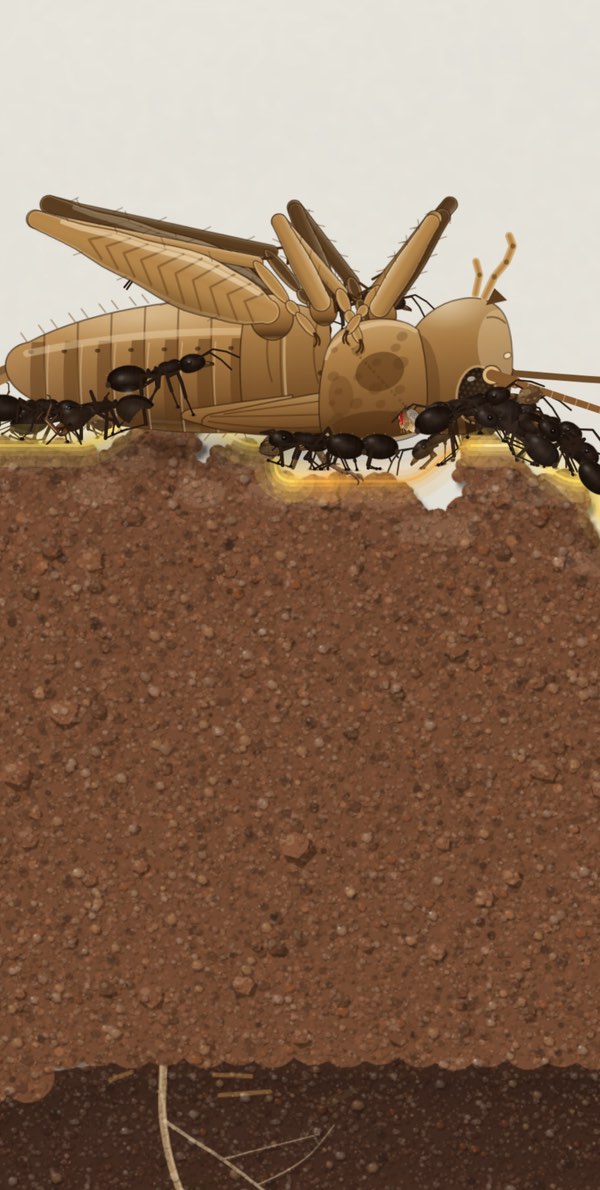
Drop in live crickets or fruit flies, and meat-eating ants chase them down. One ant bites, calls her nestmates, and together they drag the prey home. A cricket struggles, then is torn apart at the door and carried in piece by piece. Vegetarian ants leave live prey alone.
There is more on the menu too: strawberries and blueberries, and leaves for the leafcutters to cut up. Real ants hunt and carry big prey as a team, and the game follows the studies of how they do it.
The seventh species
A new home for turtle ants
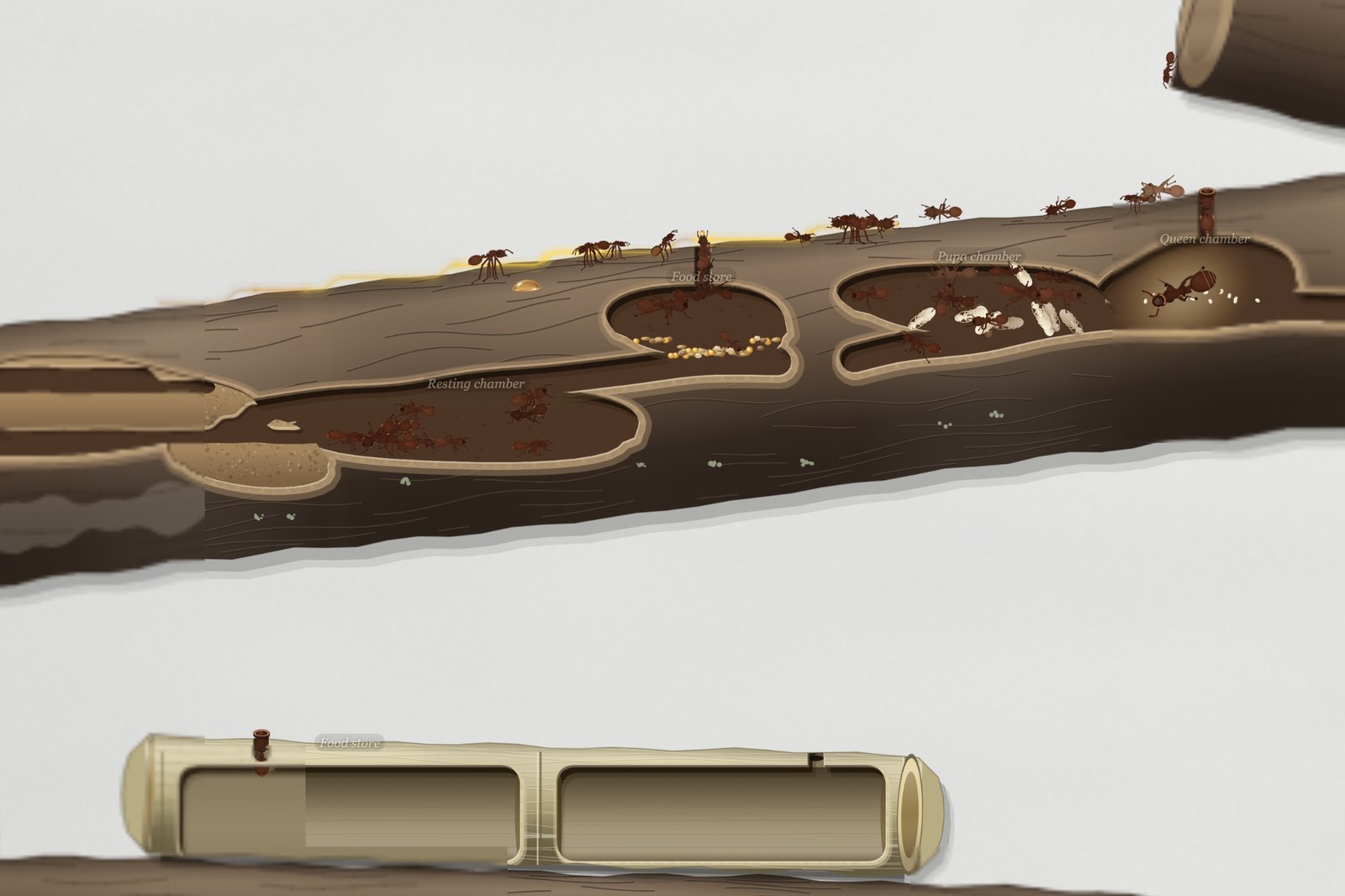
Turtle ants (Cephalotes varians) do not dig. Their tank is a network of sticks, forks, branches and bamboo, with bridges between them. They move into the old beetle holes in the wood through small round doors, and a soldier blocks each door with her flat, round head, as in real colonies.
Through the open port
A wolf spider, and the zombie-ant fungus
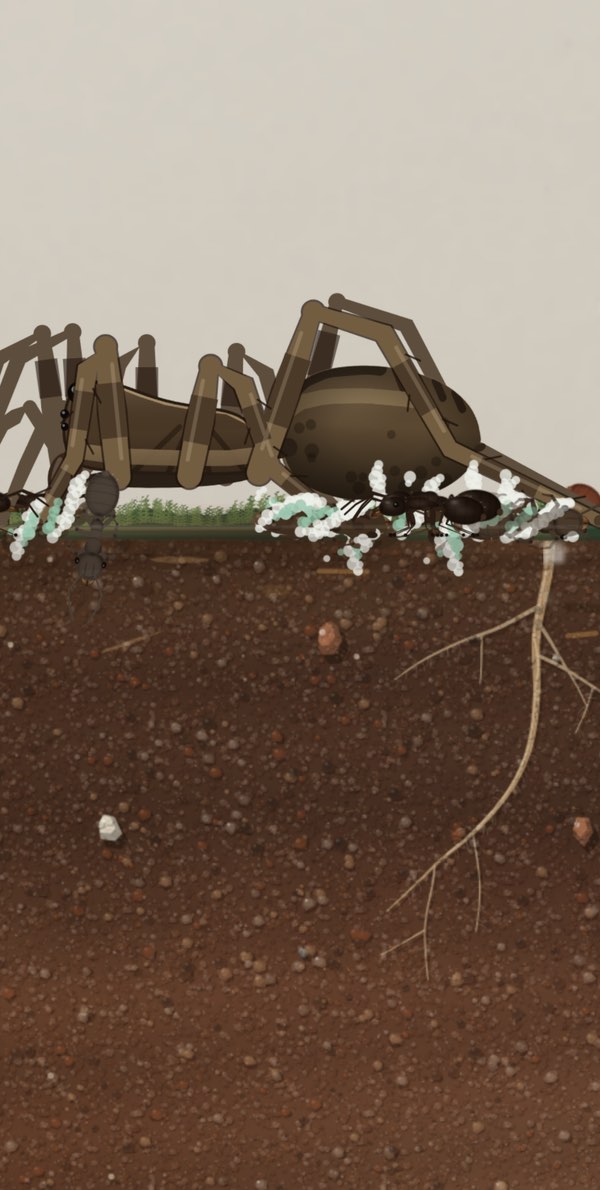
Open the access port, and the outside can get in. About once a month a wolf spider wanders into the ant farm, and the ants gather to deal with it.
If your colony is carpenter ants, a worker coming home can carry the zombie-ant fungus in. In the wild it makes an infected ant climb a plant and bite down before she dies. Close the port to keep both out.
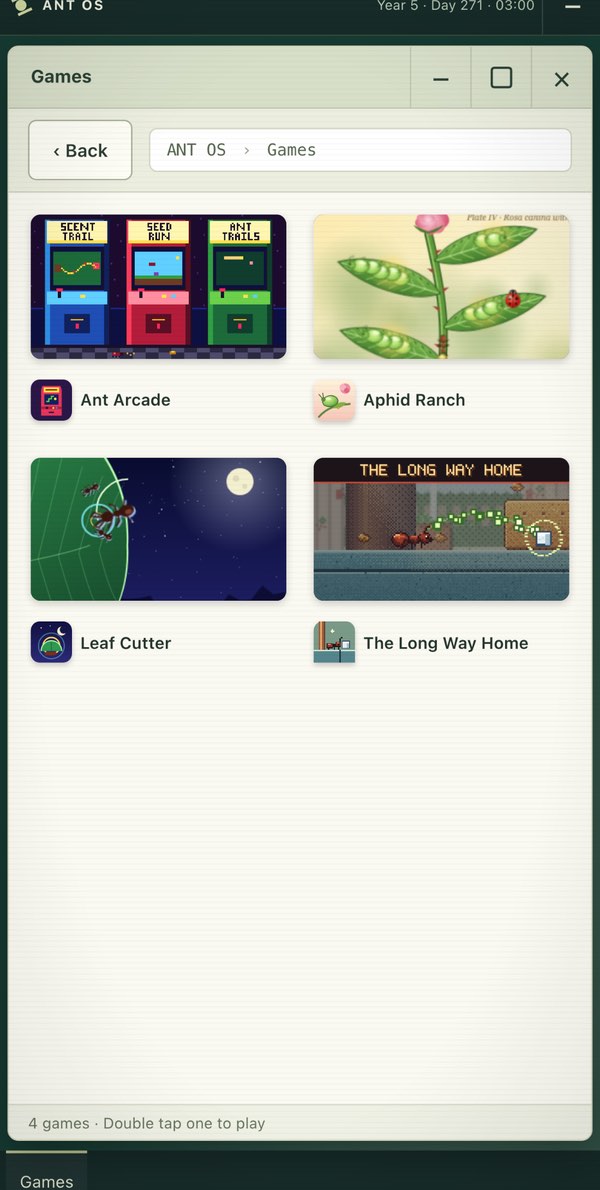
ANT OS
Games on the lab computer
The computer in the lodge runs ANT OS. Its Games folder has Ant Arcade (Scent Trail, Seed Run and Ant Trails), Aphid Ranch and Leaf Cutter, and The Long Way Home, a brand-new platformer: guide a lost scout ant through a 1990s kitchen, pantry and sink to get home.
ANT OS also has Ant Facts, each with its source, and a Credits program.
Also in 2.1
Closer to real ants
Ants that move like ants
They turn round instead of walking backwards. Their feet stay on the soil, and their bodies roll and turn in depth.
Little ant things
Ants groom themselves and each other, share food mouth to mouth, feed the larvae and the queen, and help new workers out of their cocoons.
Knock on the glass
A double tap startles the ants. A single tap never does.
The family tree
Every nest’s card tells how it began, and the Colony panel shows the family tree.
Experiments in the Lab
Change something, and the Lab tells you what to watch, then shows what happened.
Hide interface
Clear every button and label away for a clean view of your colony. One button brings them back.
Works with iPhone Duo
Your own tabletop ant laboratory
Ant Laboratory works with iPhone Duo, including its tabletop mode. Set the phone half open on a table, like a small laptop, and the top half becomes a window into the ant farm, the island or a nest. Everything you tap sits on the bottom half, and nothing sits on the fold.
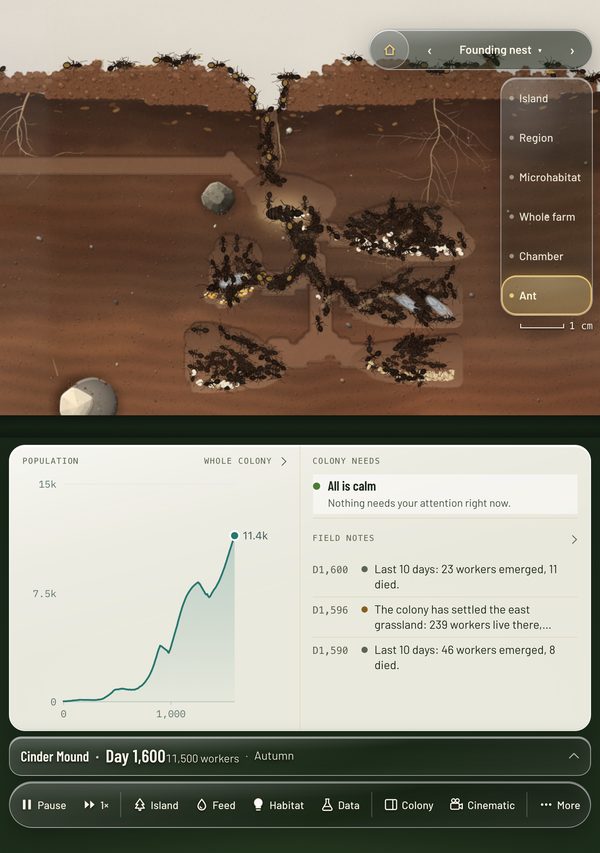
Above the fold
The colony, like a window
The ant farm, the island or a nest, with nothing in the way. Cinematic mode films up here, and the full-screen Ant cam stays here too.
Below the fold
One console, with a live dashboard
The bar runs along the bottom, and the colony panel, Data, Habitat or Weather open above it, one at a time. With no panel open, a live dashboard shows the colony’s population, its needs and the latest Field notes: tap one to go there. Cards and tips stand just under the fold instead of covering the panel.
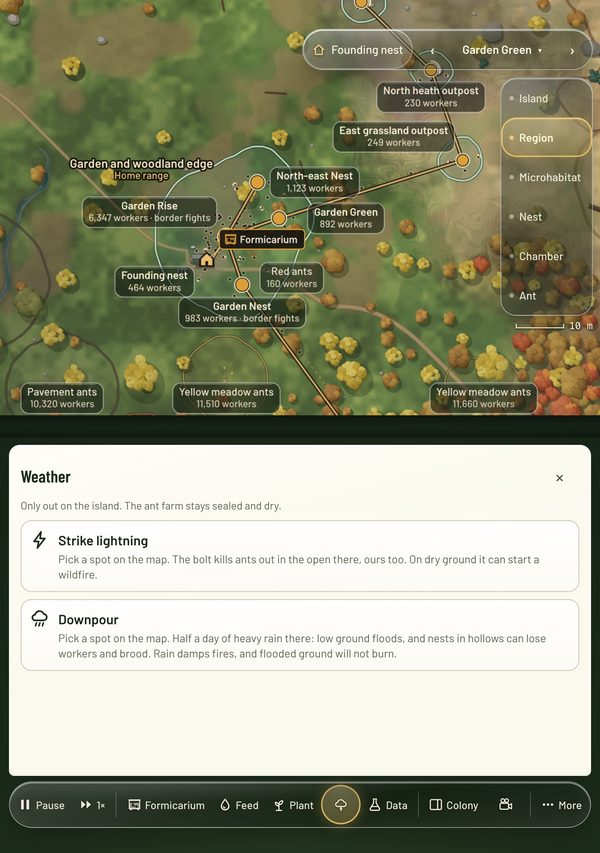
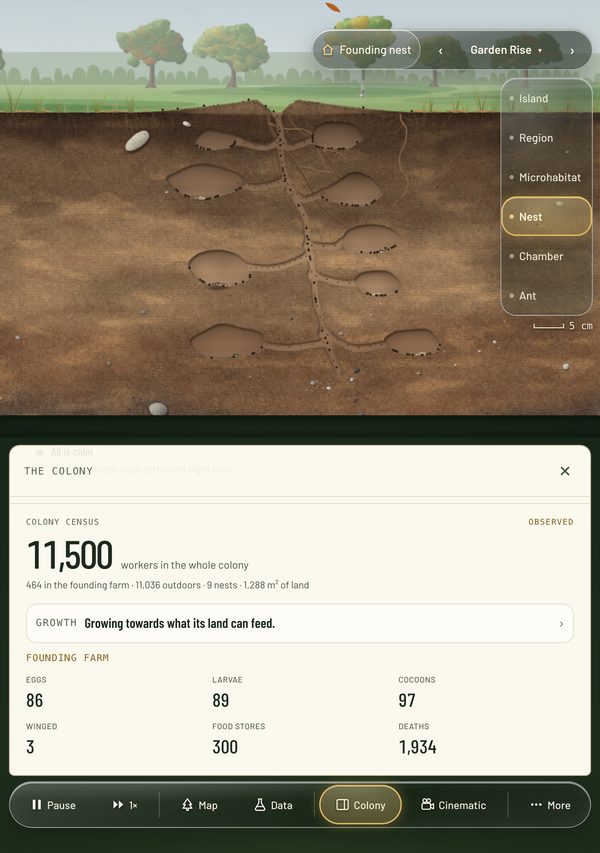
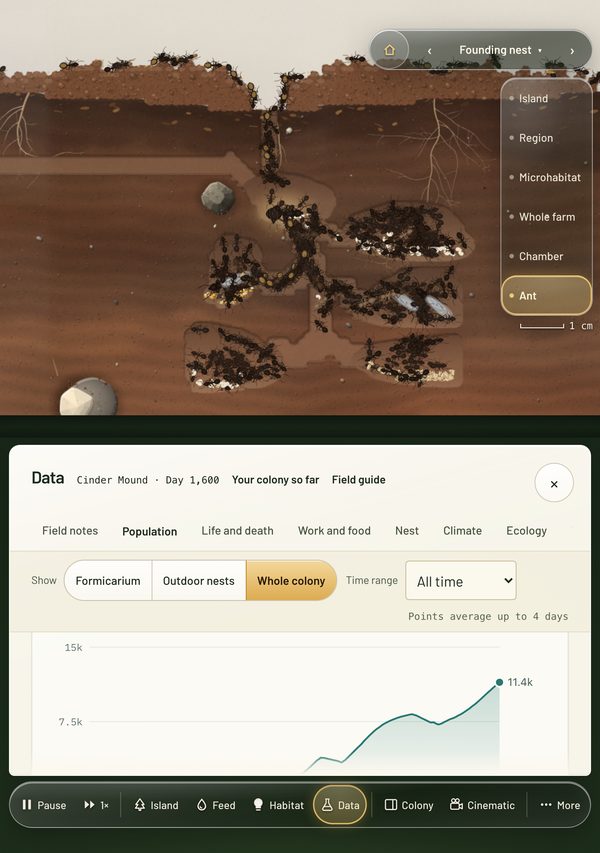
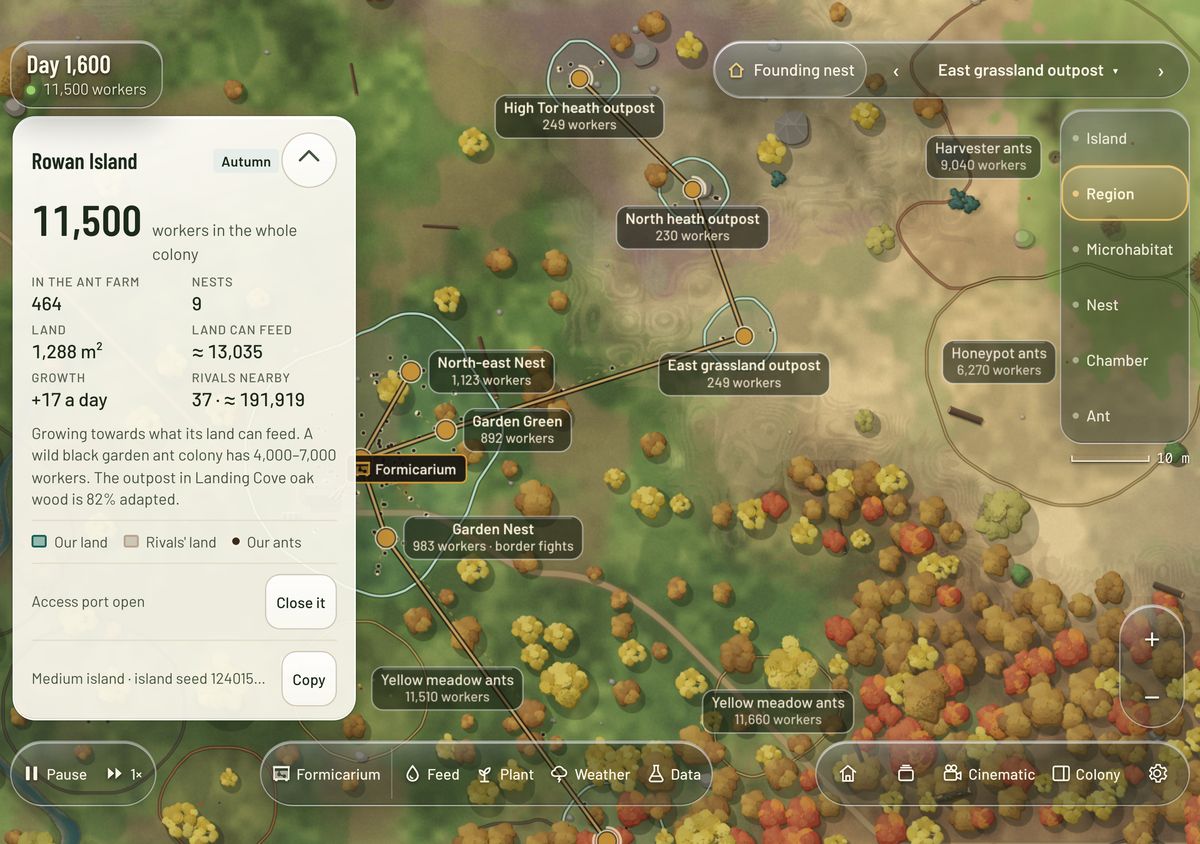
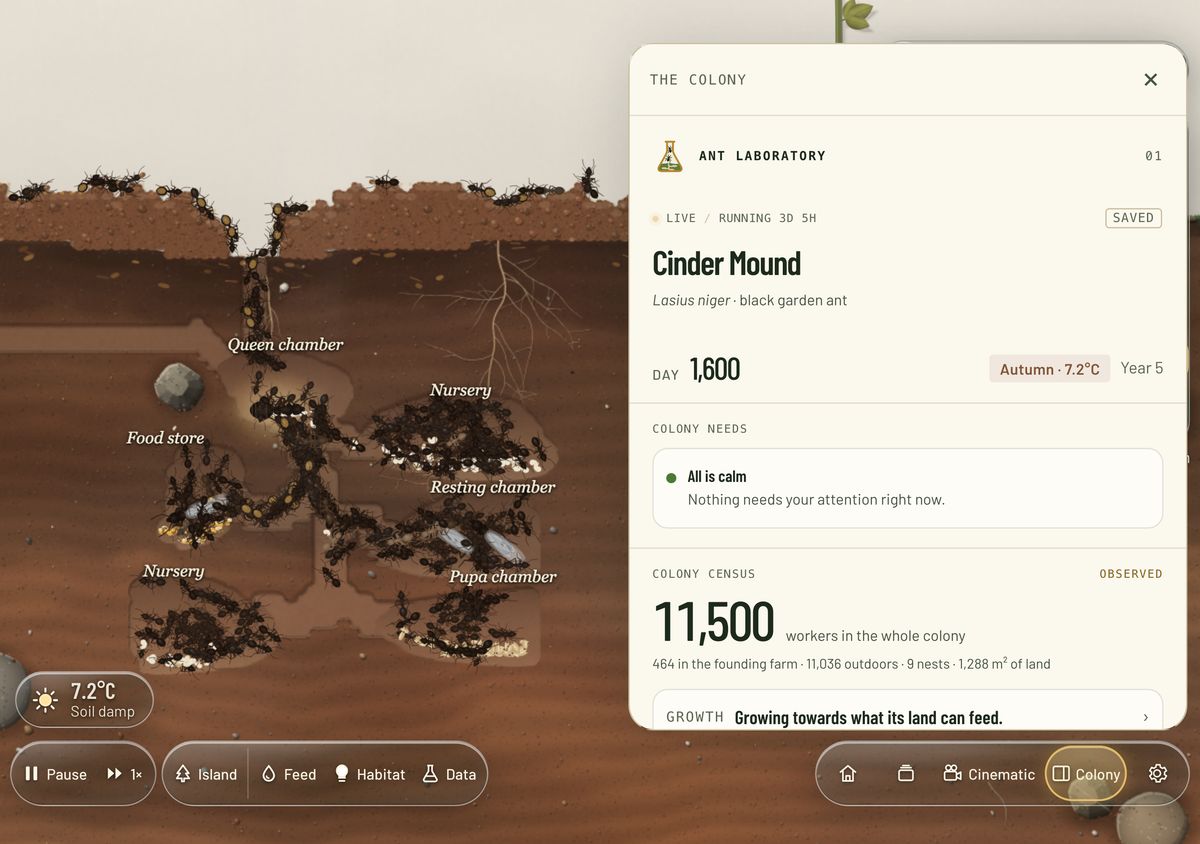
Folded
The outer screen has the phone’s layout: the bar along the bottom and the colony panel as a sheet.
Open
The inner screen has the tablet’s layout, upright or sideways. Fold or unfold whenever you like: the colony carries on, with the same view and the panels you had open.
Half open like a book
Hold it upright, half open, and the buttons, panels and cards keep off the fold. The picture of the colony runs across both pages.
The game reads only how far the phone is open and where its fold is, to lay out the screen. It keeps nothing and sends nothing. The pictures are screens from the game at the size of iPhone Duo’s inner screen. Ant Laboratory is an independent game, not endorsed by Apple.
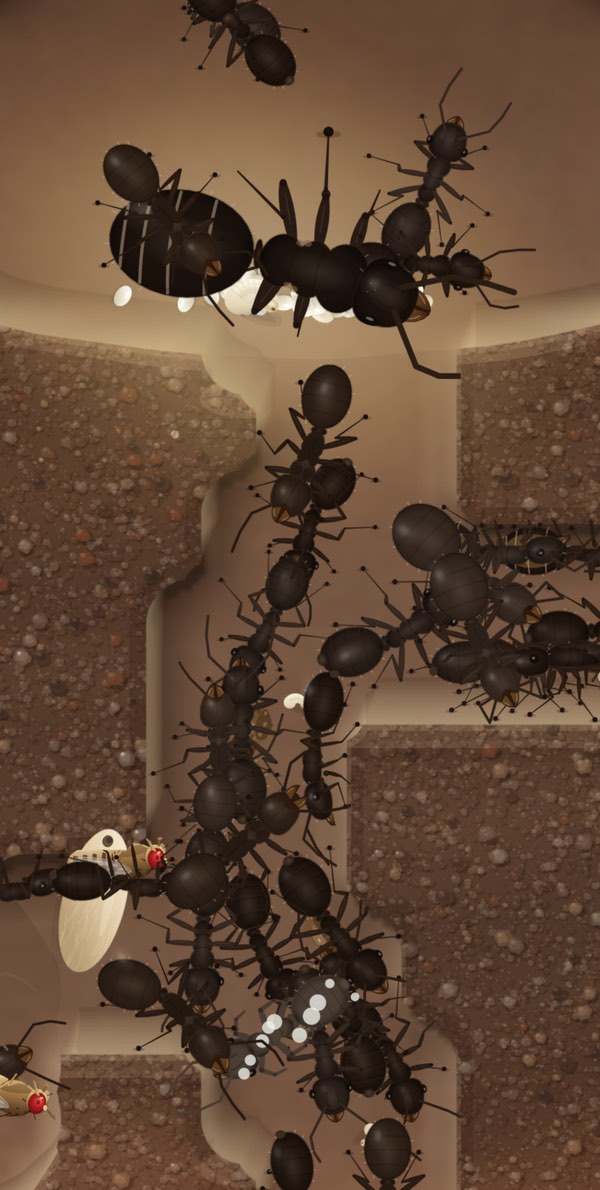
The ant farm
A colony that runs itself
Choose one of seven species and a soil for its farm, then release the queen. Watch the first workers emerge, and the colony takes over. Nurses feed the larvae, diggers carve tunnels and rooms, foragers lay scent trails to food and carry it home, and undertakers usually lay the dead on a refuse heap by the entrance. Founding is simplified; the wood ant’s solo start is Experimental.
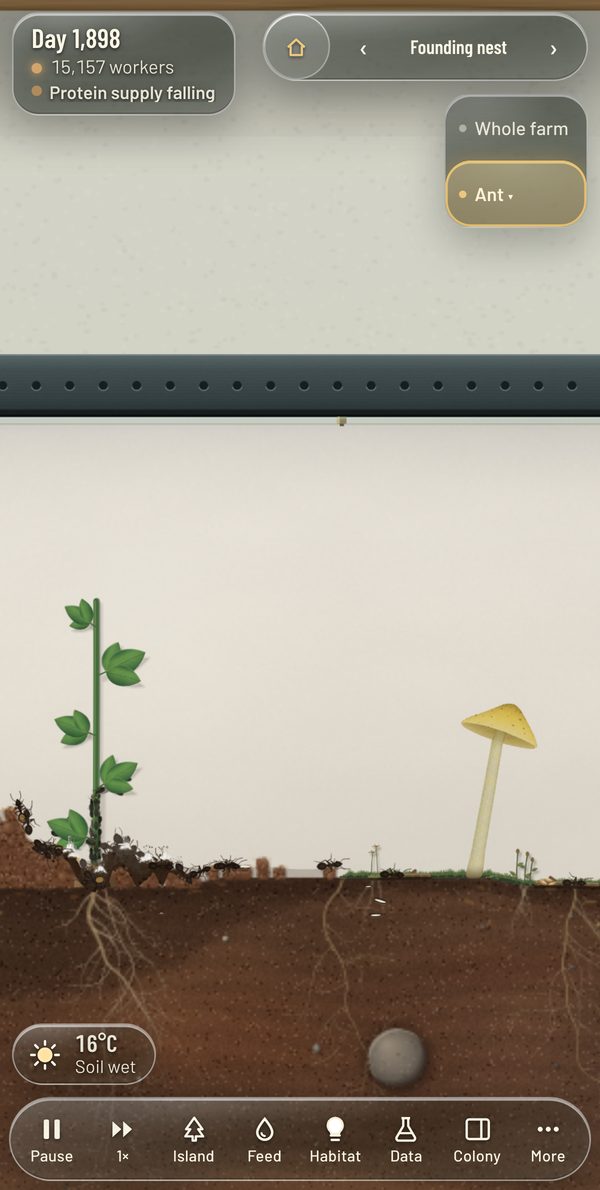
Every ant in the farm is simulated, with her own age, job and history. They walk the floors, walls and back walls of their tunnels, and some cross the glass. Tap one to see what she is doing and why, or touch and hold to follow her through the nest. Double tap the glass to knock, and the ants start.
The Ant cam
A small camera follows one ant close up and says where she is going, what she carries and why she does her job. It takes turns between the queen and busy workers, or stays with any ant you tap. Tap it to watch her full screen.
The lodge
The ant farm stands on a bench in a small lodge, a well-kept field station whose windows look out on the island’s own land in every season. Pinch out to see the whole room. Tap what is in it: the computer opens Data, a food jar opens Feed, the books open the field guide, and the magnifying lamp puts an ant under the lens. The tank has a glowing lamp, the room a light switch and a proper door. Tap the radio to play the developer’s own eight tracks; it stays off until you do. Turn on the loudspeaker on the lodge’s outside wall, and you hear the radio out on the island too, softer as you move away.
The habitat
A living formicarium
Tap Habitat to set the ant farm’s light, water and warmth. The small living things in the soil answer, as they would in a real tank.
Light
Bright, Soft or Off, any colour, and up to twice as bright. Bright light grows lush plants; dim light, sparse ones.
Water
Let it water itself, set the mister, or mist by hand where you tap. Water one side more, and the nurses move the brood to suit. The brood needs damp soil: not too dry, not too wet.
Warmth
Follow the lodge through the seasons, or set a heat mat under the whole floor or one end. Warm brood grows faster. Give a winter rest, and ants that rest in winter age more slowly.
Life in the soil
Mould grows where it is damp, and mushrooms may come up by the refuse heap. Tiny springtails graze the mould, and the ants catch them. Over weeks the bare surface turns green.
Keep the soil too dry or too wet for days, or the heat mat too hot, and some brood dies. The colony panel warns you first. Adult ants are never harmed by the habitat. How fast the surface turns green is Experimental.
Kept contained
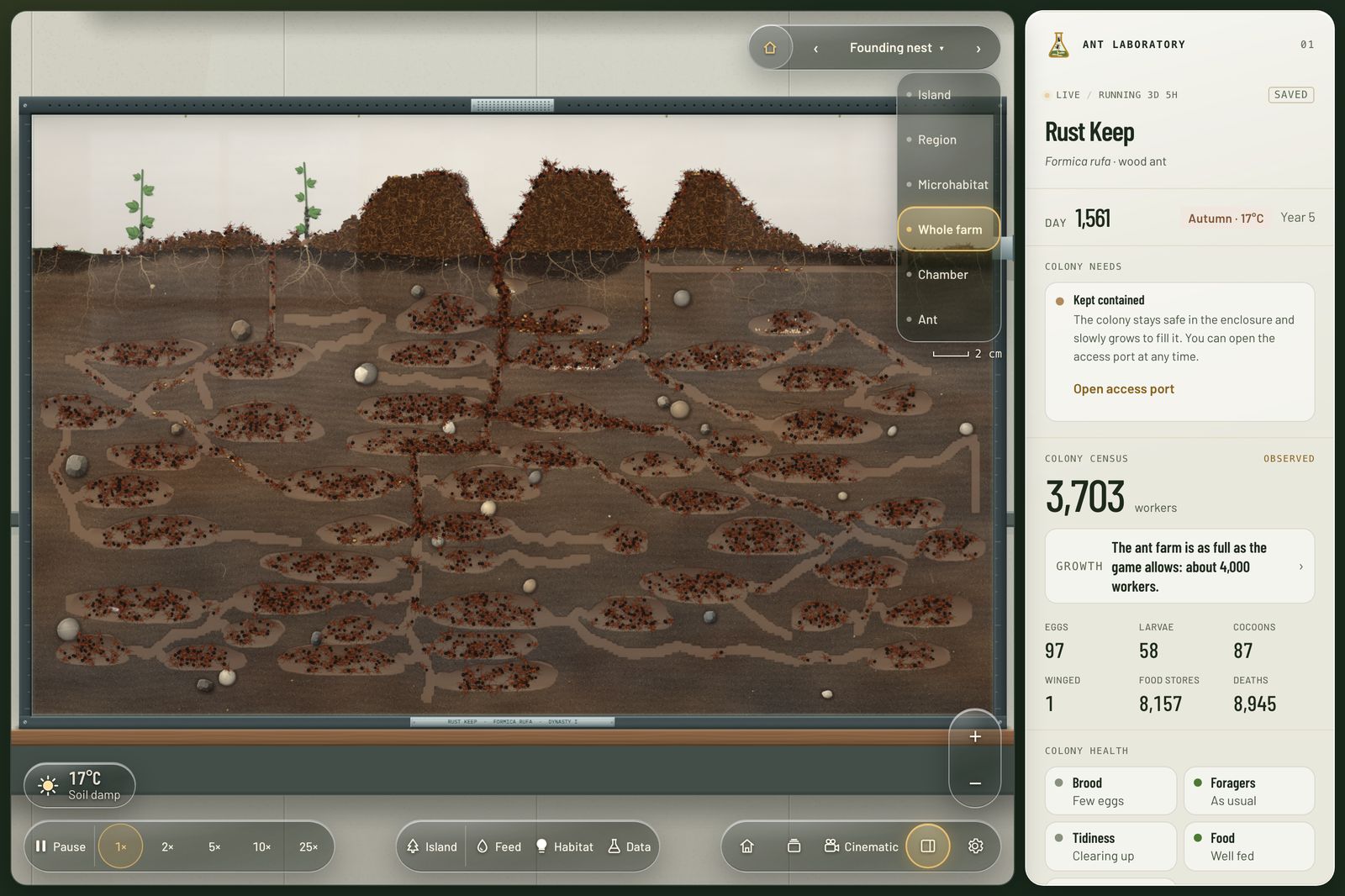
Keep it in, and it fills the whole farm
When a few hundred workers crowd the farm, you choose. Keep the colony contained, and it grows on slowly for years while it has food to spare. The workers dig new tunnels and rooms across the whole farm, with solid soil between them, up to about 4,500 ants and brood.
The island
Or let it out across an island of its own
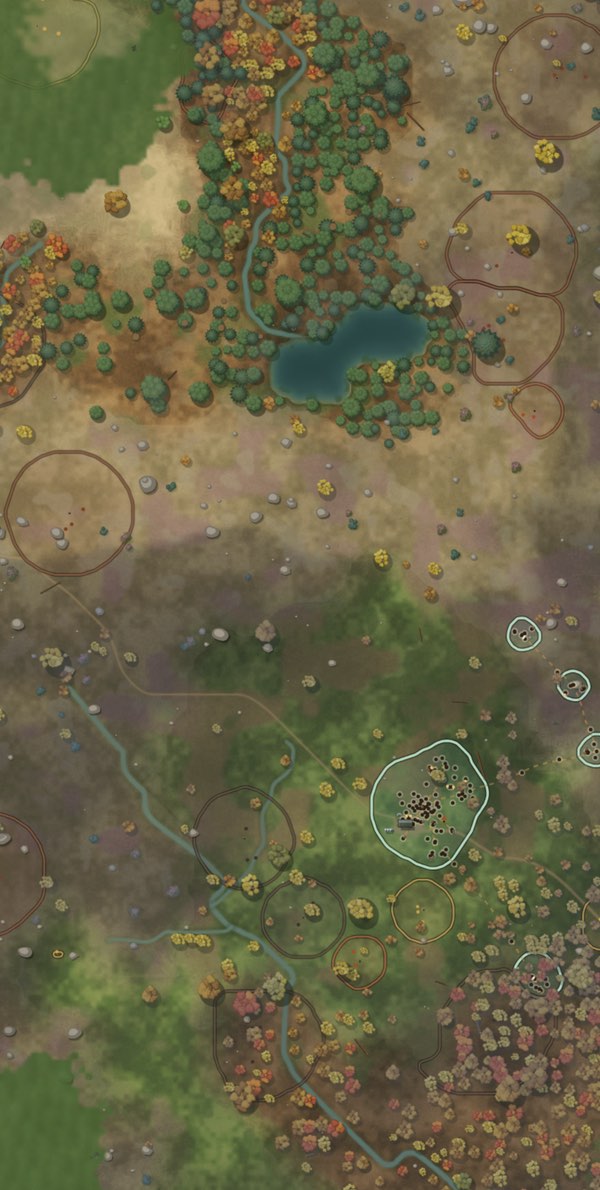
Open the access port, and a tube leads from the farm to the land outside. The queen stays in the farm while her workers go out, found outdoor nests linked by trails, and spread through woodland, meadow, heath, dunes and wetland, among rival colonies. Keep the port closed for as long as you like, and close it again whenever you want: outdoor nests cut off from a queen then slowly fade.
A living island
Your outdoor nests join the mating flight, and a few young queens found daughter colonies of their own. Wood ants grow into one supercolony. Plant trees and shrubs for aphids, watch burnt land come back green, and see young trees grow over the years.
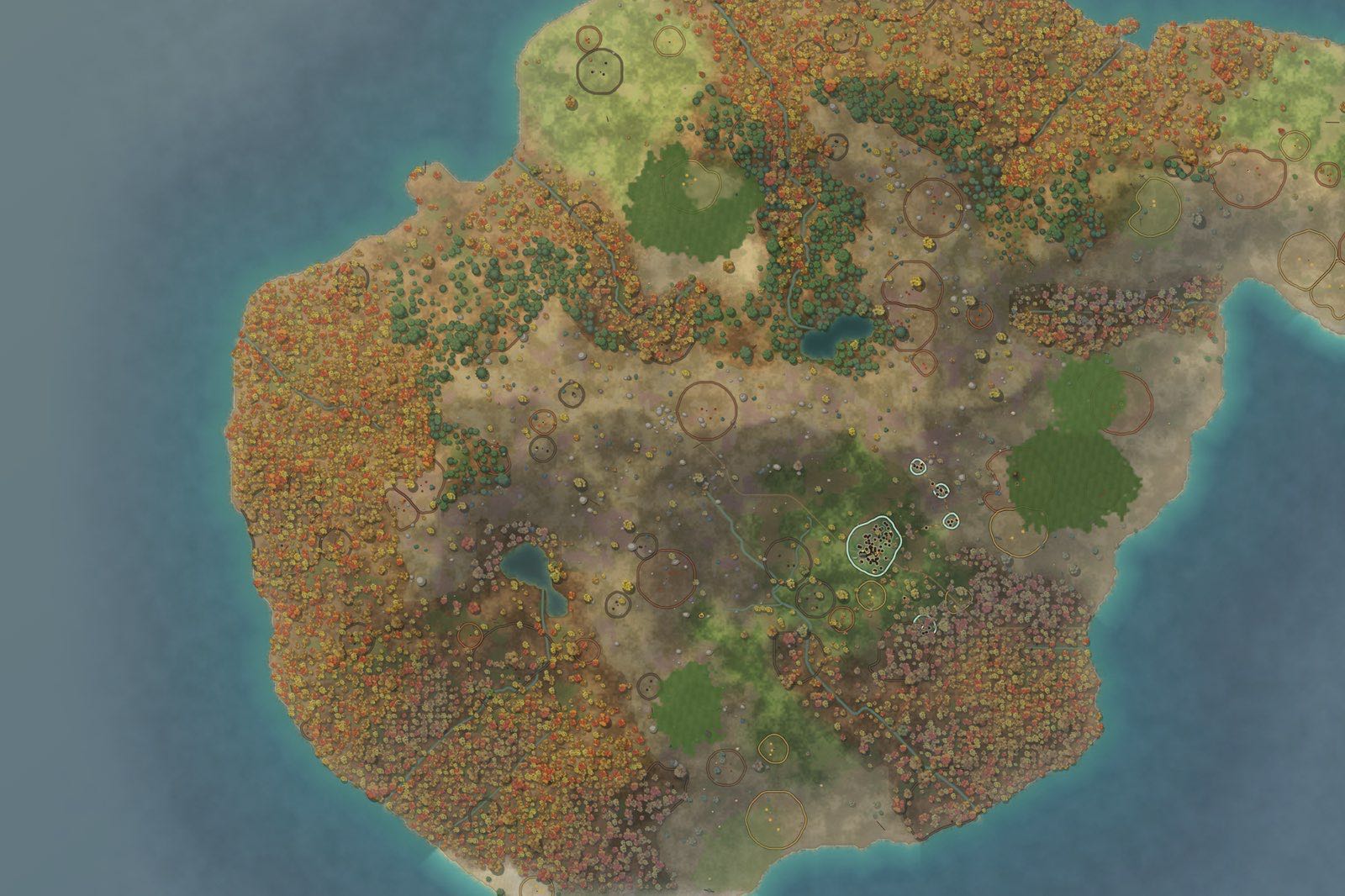
Hills and valleys shade the land, and the map looks brighter from far out. Waves break into foam along a smooth coast, and the sea runs from sand through turquoise to deep blue. Streams wind down to it in pools and riffles between grassy banks, and ponds lie in the hollows, with stones and leaves on their beds. Rain rings the water, ice cracks in winter, and storms flood the low ground.
Day and night
Night comes slowly: a day and night takes about 12 minutes, whatever the game’s speed, with stars and the moon over the island. Dawn and dusk turn golden, fire and lightning glow in the dark, and each species keeps its own hours. In Settings, the sky can follow your own clock or the colony’s quick days, or you can turn it off. The ant farm keeps its own lamp.
A new island for every colony
Each island is grown from a seed: its size and coastline, hills, streams and ponds, woods and open country, the ecosystems in its regions, and the names of its regions and landmarks. Copy the seed from the island's card on the map, and anyone who starts the same species and size with it grows the same island.
Underground
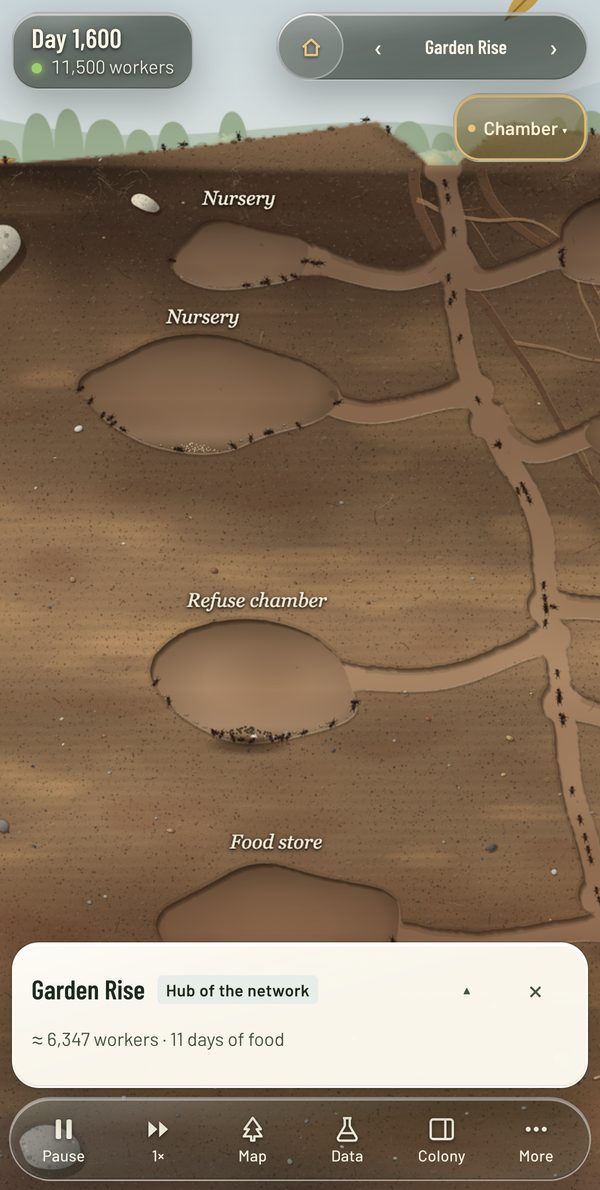
Dive inside any nest
Pinch into a nest on the map and the view dives underground: its chambers, brood and food stores, and the workers moving between them. Each species has its own nest architecture. Outdoor ants are a representative visual sample of that nest’s activity; the farm simulates its ants individually. Some cross the back walls of their rooms, and they pause now and then on their way.
The mound is the same from above and from the side: the same size, the same entrances, and snow or fallen leaves on the same days. Rival colonies build in their own ways: thatch mounds, fungus gardens, seed granaries, galleries in wood.
The seasons
The island changes through the year
A year passes in a little over an hour at 1×. The land, the view from the lodge's windows and the sounds all follow it.
Spring
Fresh leaves and new grass, and blossom on the flowering trees. Birds sing a dawn chorus, and resting colonies wake up.
Summer
Deep greens, then dry grass bleaching to straw late in the summer. Grasshoppers drone, and big colonies send out winged queens and males.
Autumn
The leaves turn gold, orange and red, then fall and lie on the ground. Dry leaves rustle, the wind gusts and geese fly over.
Winter
Bare trees. In a cold winter snow settles on the land and the mounds, and the ponds freeze. Most species rest deep in the nest until spring.
Winter follows the island's climate: snow and ice where it is cool, a wet grey winter where it is warm or dry, and none in the tropics.
Weather
Wildfires, storms and weather you call
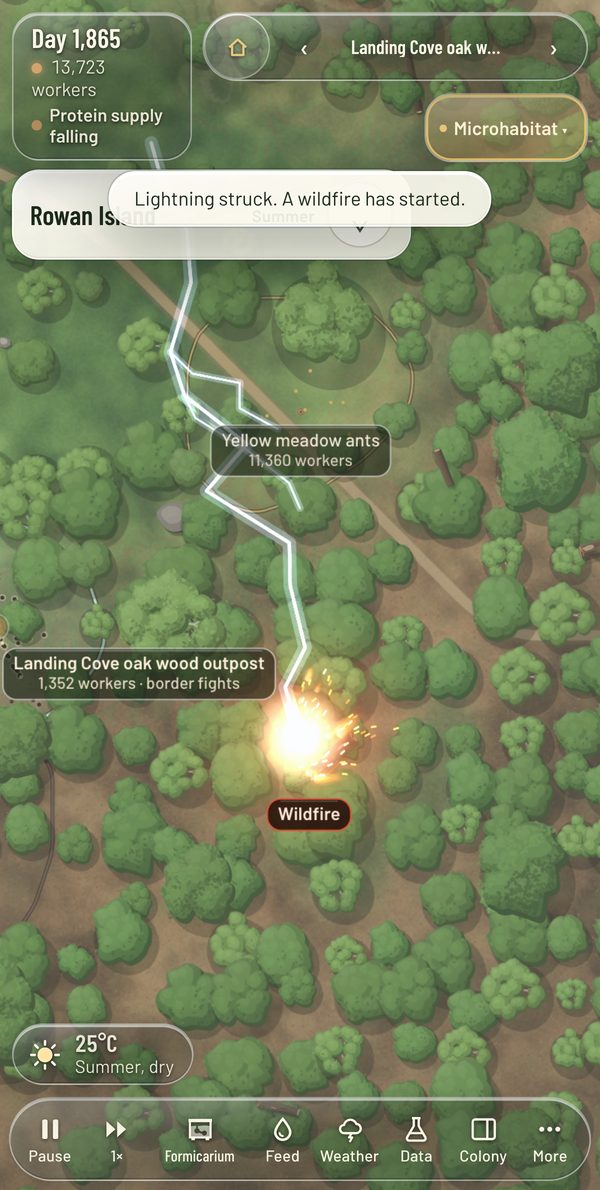
Out on the land, storms flood the low ground and fill nests from the bottom up, droughts wither the plants, and lightning sets dry ground alight. The wind drives a fire on until it meets a stream, a track or rain, and the burnt ground grows back greener than before. Wolf spiders hunt at the nest entrances, and fungal disease spreads on damp ground.
You can call the weather too. On the map, tap Weather to strike lightning where you tap (it kills ants in the open, yours too, and can start a fire on dry ground) or to call a downpour that floods the low ground. Every bolt and downpour is noted in Field notes. Weather never reaches the ant farm.
Data
Study it like a scientist
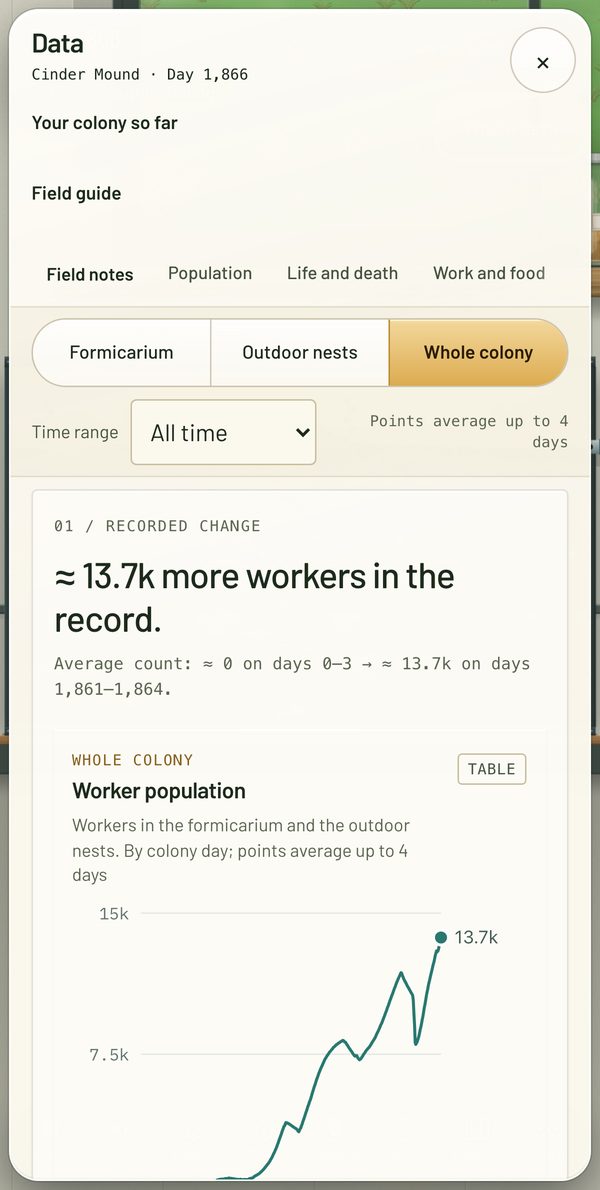
Data opens to Field notes, with measured changes to explore at your own pace. There are no required research tasks. It measures the colony every day: population and brood, births and deaths by cause, lifespans and survival, who does which job, food and diet, soil temperature and water, ecology and territory. Choose what it shows: the formicarium, the outdoor nests or the whole colony. Every chart has a table view, and the data exports as spreadsheet files for your own analysis.
The biology is real where it can be. The rates are sped up so a colony's life fits into hours of play, and anything beyond real biology is marked Experimental.
On iPad and Mac
More room for the whole colony
On a bigger screen the colony's numbers, needs and queen sit beside the world when you hold it sideways, and slide in from the edge when you hold it upright. On a Mac with Apple silicon, it plays from the same App Store purchase.
Observation
Watch, inspect, investigate
Observer
Relax and watch. The feeder keeps the colony fed, and it makes its own decisions.
Inspect
Follow a worker, examine her under the lens, look inside a chamber and see where food goes. The field guide shows each species at true size.
Investigate
Start with Field notes, compare the charts and export the records. Each change you make is flagged on the charts: add your own notes and compare before and after.
Your pace
At 1× a colony day passes in 12 seconds; go up to 25× faster, or pause. When you leave, it waits right where you left it.
Quiet sounds
Wind, rain, insects, birds, streams and surf follow the place, the season and the weather. Most are recordings the developer made. Very close to the glass, you hear the ants rustle through the soil.
The lodge radio
The only music comes from a radio on the bench: eight tracks of the developer’s own. It stays off until you tap it. Turn on its loudspeaker to hear it on the island near the lodge.
Cinematic mode
Hold your chosen view or tour the formicarium. Once the access port is open, tour the whole colony too. Optional summaries describe what is happening. Touch the screen to return to your controls.
Feed the island
Scatter seeds, sugar, flies or crickets by an outdoor nest: sugar ends hunger, insects feed the brood. The nests live off their land, so it is extra help, never a chore.
A view to share
Cinematic hides the controls and labels. Leave its summaries off to show just the living world, with a fixed view or a moving camera.
Home and your settings
Resume, start a new colony or open your saves from Home. Choose a light or dark interface theme; the colony’s own colours stay the same.
Its own story
When the colony is full-grown, it tells its story so far: its queens, its growth and its firsts. Data keeps it for you to read again. If a colony dies out, the game says so and offers a new one.
Many colonies
Start as many as you like, each on its own island, and switch between them. Export one to keep or share. A colony that died out stays in the list. Delete one, and a recovery copy stays in case you change your mind.
Seven species
Each with its own nest, diet and habits
- Black garden antLasius nigerFarms aphids for honeydew at a garden's edge.
- Fire antSolenopsis invictaSmall, fierce and fast-growing; in a flood the workers form rafts.
- Wood antFormica rufaBuilds a thatch mound; colonies may have one queen or several.
- Leafcutter antAtta sexdensCuts leaves to grow a fungus garden, from tiny gardeners to big soldiers.
- Carpenter antCamponotus pennsylvanicusCarves its galleries in rotting wood; big, slow and patient.
- Harvester antPogonomyrmex barbatusGathers seeds into granaries on dry grassland.
- Turtle antCephalotes variansLives in hollow twigs and branches; soldiers plug the doors with their flat heads.
After the species, choose the soil for its farm, as you would for a real tank: garden loam, sand, clay, woodland humus, stony soil or wetland soil. Your species’ own soil is picked first. The soil changes only the look; the ants live and dig the same in every soil. Turtle ants don’t dig, so their tank of wood gets a floor to stand on instead.
Follow the colony
Videos, news and other players
Watch colonies at work, hear about updates first, and share your own colony with other players.

@antlaboratorysim
Pictures and clips from the game.
TikTok
@antlaboratory
Short videos of colonies at work.

r/antlaboratory
The players’ community: share your colonies and island seeds, ask questions and suggest ideas.
u/antlaboratory
The developer’s own account, with news and answers.
Pay once. It's yours.
No ads, no in-app purchases, no accounts and no tracking. Ant Laboratory works offline and keeps your colonies on your device.
Coming soon to the App Store
US$4.99, paid once, for iPhone and iPad with iOS 15 or later and Macs with Apple silicon. Works with iPhone Duo, including tabletop mode.
On Android? Join early access on Google Play. Coming soon to Steam: Windows and Mac.